
THE QUESTION UNDERNEATH
What people are really asking
When people ask me how to regulate their nervous system, they're usually asking a different question underneath: how do I stop feeling like this? The racing thoughts at 2 a.m. The tight chest at the morning meeting. The shutdown that arrives without warning at the end of a long week.
A regulated nervous system isn't one that's always calm. It's one that recovers — that can mobilize when you need to act, and settle when the moment has passed. The good news: this is a trainable capacity. The body comes with the equipment. Most of us were just never taught how to use it.
WHAT TO NOTICE
Two flavors of dysregulation
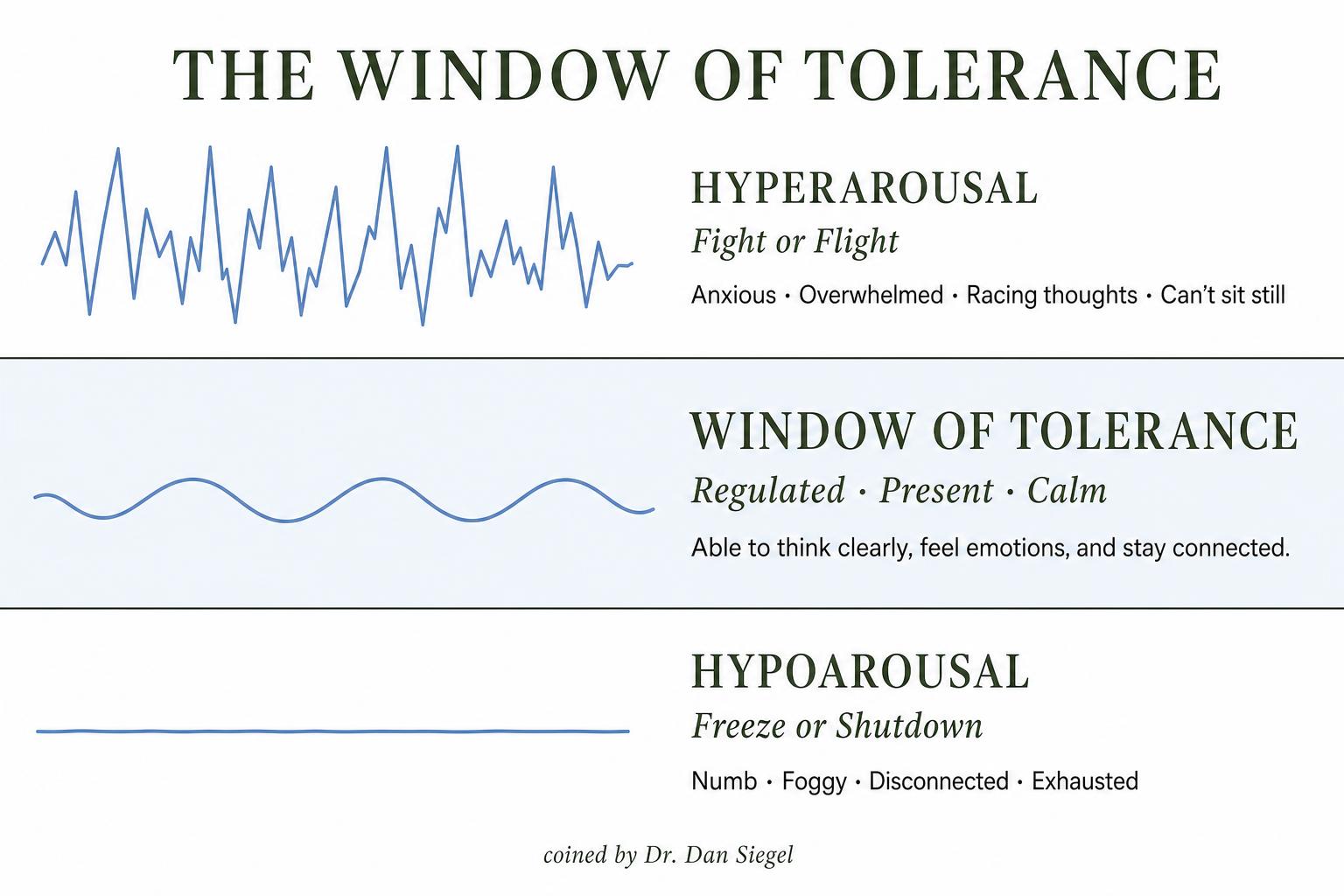
Dysregulation shows up in two broad flavors, and most of us live somewhere on the spectrum between them.
HYPERAROUSAL
Wired
Anxious, irritable, hypervigilant. Can't sit still, mind racing, trouble sleeping.
HYPOAROUSAL
Shut down
Flat, foggy, numb. Exhausted, disconnected, hard to feel present.
You can swing between both within a single day. That's not a personality flaw — that's a nervous system that hasn't been taught the path back to the middle.
Here's what makes dysregulation so costly: when you're outside your window, an important part of your brain called the prefrontal cortex goes offline. That's the region responsible for focus, decision-making, emotional regulation, and creativity. Which is why, when you're dysregulated, you can't think clearly, can't get things done, and can't feel your best — no matter how hard you try. Regulation isn't a luxury. It's what brings your full brain back online.
THE SCIENCE, BRIEFLY
Flow between states
Your autonomic nervous system has two main branches. The sympathetic branch mobilizes you for action. The parasympathetic branch — specifically the ventral vagal pathway — brings you into rest, connection, and safety. Stephen Porges' Polyvagal Theory describes a third state, dorsal vagal shutdown, that the body drops into when activation feels unsurvivable.
Regulation isn't about staying in one state. It's about flow between them. The practices below are small, daily inputs that train that flow.